 PT
 EN
 ES
 FR
Rights and legislation
Indigenous rights in the 1988 Constitution
Articles 231 and 232 replaced the goal of integrating Indigenous peoples with the recognition of their own organization and of original rights over their lands. The Constituent Assembly heard Indigenous leaders, the demarcation deadline was not met and the marco temporal remains in dispute between the STF and Congress.

What Articles 231 and 232 say
The 1988 Constitution devotes a chapter of its own to Indigenous peoples, Chapter VIII of Title VIII, which has two articles. The main text (caput) of Article 231 reads: “São reconhecidos aos índios sua organização social, costumes, línguas, crenças e tradições, e os direitos originários sobre as terras que tradicionalmente ocupam, competindo à União demarcá-las, proteger e fazer respeitar todos os seus bens.” (original wording of the legal text) (“The Indians' social organization, customs, languages, beliefs and traditions are recognized, as are their original rights over the lands they traditionally occupy, it being incumbent upon the Union to demarcate them and to protect and ensure respect for all of their property.”)1
The text does not leave the expression “terras tradicionalmente ocupadas” (lands traditionally occupied) open. Paragraph 1 says they are the lands inhabited on a permanent basis, those used for productive activities, those indispensable to the preservation of the environmental resources needed for their well-being, and those necessary for their physical and cultural reproduction, according to their uses, customs and traditions. Under Paragraph 2, these lands are intended for the permanent possession of Indigenous peoples, who have the exclusive usufruct of the riches of the soil, rivers and lakes.23
The following paragraphs set out the guarantees. Using water resources, including to generate energy, and prospecting for or extracting minerals on these lands requires authorization from the National Congress, with the affected communities heard and given a share in the results of the mining. The lands are inalienable and unavailable, and the rights over them do not lapse. It is forbidden to remove Indigenous groups from their lands, with narrow exceptions that depend on Congress, and their return must be immediate once the risk ceases. Acts of occupation, ownership or possession of these areas are null and void, except for a relevant public interest of the Union (the federal government) defined in a complementary law, and there is no compensation against the Union, except for improvements made in good faith.4567
Article 232 is short: “Os índios, suas comunidades e organizações são partes legítimas para ingressar em juízo em defesa de seus direitos e interesses, intervindo o Ministério Público em todos os atos do processo.” (original wording of the legal text) (“The Indians, their communities and organizations are legitimate parties to bring suit in defense of their rights and interests, with the Public Prosecutor's Office (Ministério Público) intervening in all acts of the proceedings.”) According to the anthropologist Manuela Carneiro da Cunha, who took part in the process, this text entered the proposal of the organizations at the suggestion of the jurist Dalmo Dallari. It affirmed the legal capacity of Indigenous peoples and entrusted their defense to the Public Prosecutor's Office.816
Other parts of the Constitution also deal with the subject. The lands traditionally occupied are property of the Union (Article 20, XI). Legislating on Indigenous populations is an exclusive competence of the Union (Article 22, XIV). Disputes over Indigenous rights are judged by the Federal Courts (Article 109, XI), and defending these rights in court is one of the functions of the Public Prosecutor's Office (Article 129, V).9
Before 1988: integration and guardianship
Before 1988, the main law on the subject was Lei 6.001 (in Portuguese) of December 19, 1973, known as the “Estatuto do Índio (in Portuguese)” (Indian Statute). Its Article 1 says that the purpose of the law was to preserve Indigenous culture and to integrate Indigenous people “progressiva e harmoniosamente, à comunhão nacional” (“progressively and harmoniously, into the national communion”). The law classified Indigenous people as isolated, in the process of integration and integrated, and placed those not yet integrated under a guardianship regime.11
Guardianship came from earlier. According to Carneiro da Cunha, the 1916 Civil Code placed Indigenous people among the “relativamente capazes” (“relatively capable”), under the guardianship of the Union, which delegated it first to the SPI (Serviço de Proteção aos Índios, Indian Protection Service), from 1916 to 1967, and then to Funai (Fundação Nacional dos Povos Indígenas, Brazil's federal Indigenous affairs agency). In practice, some judges held that only Funai, as guardian, could represent them in court.12
The same author recalls that the Constitutions of 1946, 1967 and 1969 gave the Union the power to legislate on the “incorporação dos silvícolas à comunhão nacional” (“incorporation of the forest dwellers into the national communion”). Official agencies read this as assimilation. In her view, this program was “expressamente revogado” (“expressly revoked”) by the main text of Article 231, which recognizes each people's own social organization. Indigenous rights to land had appeared in the constitutions since 1934, but 1988 was the first time they were given a specific chapter.1314
The basis of the chapter is the idea of original rights. Carneiro da Cunha explains that Indigenous territorial rights predate the State itself and derive from the indigenato (indigenate), according to the jurist João Mendes Júnior (1912). In the 2023 ruling, the Supremo Tribunal Federal (STF, Brazil's Supreme Court) stated that these rights are original, that they “preexistem e são oponíveis a qualquer outro direito” (“pre-exist and can be asserted against any other right”), and that demarcation is a declaratory procedure: it recognizes the right, it does not create it.15
The 1973 Statute was not repealed as a whole. The law is still on the official legislation website and was amended in 2023. What changed was the starting point: instead of the goal of integration, the Constitution recognizes each people's own organization and the capacity to go to court on its own.38
Indigenous peoples in the Constituent Assembly
Indigenous peoples took part in the National Constituent Assembly (1987–1988). On September 4, 1987, in the Systematization Committee (Comissão de Sistematização), meeting in the plenary chamber of the Chamber of Deputies, Ailton Krenak (in Portuguese) defended Popular Amendment No. 40 (Emenda Popular nº 40), on Indigenous populations. He was president of the União das Nações Indígenas (UNI, Union of Indigenous Nations) and, during his speech, painted his face black.17
According to the official transcript, Krenak said: “Não estamos chegando agora a esta Casa” (“We are not arriving at this House just now”). He recalled Indigenous participation in the Subcomissão dos Negros, Populações Indígenas, Pessoas Deficientes e Minorias (Subcommittee on Black People, Indigenous Populations, Persons with Disabilities and Minorities) and in the Comissão da Ordem Social (Committee on the Social Order). He described the gesture as an expression of indignation “que pode expressar também luto” (“which may also express mourning”).18
The speech responded to a difficult moment. According to the Instituto Socioambiental (in Portuguese) (ISA), the UNI and representatives of several peoples had gathered more than 100,000 signatures in favor of including Indigenous rights in the new Constitution. Shortly before the speech, part of the press began a campaign saying that Indigenous peoples were acting against the interests of the State. Carneiro da Cunha recounts that this campaign led to the disfigurement, in the systematization phase, of the text already approved in the initial phases. She also records that the UNI, created in 1980, was a fundamental interlocutor in the Constituent Assembly.1920
The mobilization continued in 1988. According to the ISA, in May of that year about 120 Indigenous leaders, from approximately fifty peoples, held a three-week vigil in Brasília. On June 1, 1988, the chapter was approved by 497 votes to 5, with 10 abstentions, figures the ISA attributes to the memoirs of Beto Ricardo. The Constitution was promulgated on October 5, 1988.2122

Demarcation and the five-year deadline
The main text of Article 231 assigns to the Union the demarcation of Indigenous Lands (Terra Indígena, TI — a legal category under Brazilian law). Article 67 of the Ato das Disposições Constitucionais Transitórias (in Portuguese) (ADCT (in Portuguese), the Temporary Constitutional Provisions Act) set a deadline: “A União concluirá a demarcação das terras indígenas no prazo de cinco anos a partir da promulgação da Constituição.” (“The Union shall conclude the demarcation of Indigenous lands within five years of the promulgation of the Constitution.”)123
The deadline was nothing new. Article 65 of the 1973 Statute had already ordered the demarcation, within five years, of the lands not yet demarcated. Carneiro da Cunha notes that the obligation was repeated in the ADCT (in Portuguese), with a deadline of 1993, and that as of 2018 it had not been fully met.24
In December 2025, the STF recognized that this failure is an unconstitutional omission. In ruling on ADC 87 (a declaratory action of constitutionality) and ADIs 7582, 7583 and 7586 (direct actions of unconstitutionality), it gave the Union ten years to conclude the pending demarcation processes and 180 days to comply with several orders.25
The marco temporal: STF and Congress
The marco temporal (time-frame) thesis holds that Indigenous peoples would only have a right to the lands they occupied on October 5, 1988, even if the community had been forcibly expelled before that date. The Articulação dos Povos Indígenas do Brasil (in Portuguese) (Apib, Articulation of Indigenous Peoples of Brazil) calls the thesis “inconstitucional e anti-indígena” (“unconstitutional and anti-Indigenous”).26
At the STF, the case judged with general repercussion (a ruling binding on other courts) was Extraordinary Appeal (Recurso Extraordinário) 1.017.365: according to the Apib, the decision serves as a guideline for demarcation processes in the country. It is a possessory action over the Indigenous Land of the Xokleng (in Portuguese), Kaingang (in Portuguese) and Guarani peoples in Santa Catarina (in Portuguese), with the state of Santa Catarina on the other side. On September 21, 2023, the court rejected the marco temporal by 9 votes to 2. André Mendonça and Nunes Marques voted in favor of the thesis.2728
On September 27, 2023, the Plenary set the thesis of Tema 1.031 (Theme 1.031), in 13 items, with Edson Fachin as rapporteur. Item III says that constitutional protection “independe da existência de um marco temporal em 5 de outubro de 1988 ou da configuração do renitente esbulho” (“does not depend on the existence of a time frame of October 5, 1988, or on a finding of persistent dispossession”). According to the STF, at least 226 cases were awaiting this definition. The thesis also provides for compensation by the Union, under certain conditions, to those who held just title or good-faith possession of the area. And it says that Indigenous peoples may be parties to proceedings concerning their interests, without excluding Funai and the Public Prosecutor's Office.2930
Congress went in another direction. On that same September 27, the Senate approved bill PL 2.903/2023 (in Portuguese), which set the time frame at 1988. Lei 14.701 (in Portuguese) (the marco temporal law) was signed on October 20, 2023, with vetoes on its main points. On December 14, Congress overrode part of these vetoes, and the restored provisions were published in the Diário Oficial (official gazette) on December 28, 2023. One of them, Article 4, ties traditional occupation to the date the Constitution was promulgated. The same law amended the 1973 Statute to refer to lands “tradicionalmente ocupadas em 5 de outubro de 1988” (“traditionally occupied on October 5, 1988”).3132
The STF returned to the subject when ruling on ADC 87 and ADIs 7582, 7583 and 7586, which deal with the new law. In a virtual session that ended on December 19, 2025, it declared unconstitutional the provision of Lei 14.701 (in Portuguese) that establishes the marco temporal and reaffirmed its 2023 understanding. The rapporteur was Gilmar Mendes, and André Mendonça dissented on this point.33
The debate is not over. As of the last recorded procedural step at the STF (September 2, 2026, in a check made on November 19, 2026), the judgment of the motions for clarification (embargos de declaração) in ADC 87 had been suspended since August 14, 2026, at the request of Justice Dias Toffoli for more time to review the case (pedido de vista). In Congress, on December 9, 2025, the Senate approved PEC 48/2023 (in Portuguese) (a proposed constitutional amendment), which writes the marco temporal into the text of the Constitution itself. In the Chamber of Deputies, as of the last recorded step (May 27, 2026), the proposal was awaiting the choice of a rapporteur in the Committee on Constitution and Justice.3435
In short, the dispute pits two readings against each other. One adopts a fixed date, October 5, 1988. The other holds that the rights are original and that demarcation merely declares them. As of November 2026, the STF had rejected the fixed date twice, in 2023 and in 2025, while Congress approved it in a law in 2023 and the Senate, in a PEC, in 2025.39
Other related rights
In education, elementary education is taught in Portuguese, and the Constitution also guarantees Indigenous communities the use of their mother tongues and their own learning processes. It also requires the State to protect the expressions of Indigenous cultures. In 2008, Lei 11.645 (in Portuguese) made the study of Afro-Brazilian and Indigenous history and culture mandatory in elementary and secondary schools, public and private.1036
Lei 14.402 (in Portuguese) of July 8, 2022, established April 19 as the Day of Indigenous Peoples (Dia dos Povos Indígenas). It repealed Decreto-Lei 5.540 (in Portuguese) of 1943, which called the date “Dia do Índio” (“Indian Day”).37
Terms
- Original rights
- Rights that exist before the State itself; demarcation only declares them, it does not create them.15
- Lands traditionally occupied
- Those inhabited on a permanent basis, used for productive activities, indispensable to environmental preservation and necessary for physical and cultural reproduction, according to uses, customs and traditions (Article 231, Paragraph 1).2
- Exclusive usufruct
- The right to use the riches of the soil, rivers and lakes of Indigenous lands, reserved to the communities (Article 231, Paragraph 2).3
- Guardianship
- A regime in which the Union, through the SPI and later Funai, exercised guardianship over Indigenous people, treated by the 1916 Civil Code as relatively capable.12
- Marco temporal
- A thesis according to which only the lands occupied by Indigenous people on October 5, 1988, would be recognized.26
- Renitente esbulho
- Persistent dispossession: a physical conflict or legal dispute still ongoing on the date of promulgation; the STF's 2023 thesis says that constitutional protection does not depend on it.29
- ADCT
- Ato das Disposições Constitucionais Transitórias (in Portuguese) (Temporary Constitutional Provisions Act), the part of the Constitution with transition rules; its Article 67 gave five years to complete the demarcations.23
Timeline
14 dates, from 1973 to 2026, in 4 periods of the text. Each date carries the number of the statement that supports it and leads to the source.
1973
Before 1988: integration and guardianship
1 dateRead the section
- 1973
Lei 6.001 (in Portuguese) (Estatuto do Índio, Indian Statute), with the purpose of integration and a guardianship regime
Statement 11
about 14 years later
1987 to 1988
Indigenous peoples in the Constituent Assembly
3 datesRead the section
- 1987
Ailton Krenak defends Popular Amendment No. 40 (Emenda Popular nº 40) in the Systematization Committee
Statement 17 - 1988
Chapter on Indigenous peoples approved in the Constituent Assembly (497 to 5, according to the ISA)
Statement 21 Promulgation of the Constitution
Statement 22
about 19 years later
2008 to 2022
Other related rights
2 datesRead the section
- 2008
Lei 11.645 (in Portuguese) makes the teaching of Indigenous history and culture mandatory
Statement 36 - 2022
Lei 14.402 (in Portuguese) establishes the Day of Indigenous Peoples (April 19)
Statement 37
2023 to 2026
The marco temporal: STF and Congress
8 datesRead the section
- 2023
STF rejects the marco temporal by 9 votes to 2
Statement 28 STF sets the thesis of Tema 1.031
Statement 29Senate approves bill PL 2.903/2023 (in Portuguese) (marco temporal)
Statement 31Lei 14.701 (in Portuguese) signed with vetoes
Statement 31Congress overrides part of the vetoes to Lei 14.701 (in Portuguese)
Statement 31- 2025
Senate approves PEC 48/2023 (in Portuguese)
Statement 35 STF declares the marco temporal of Lei 14.701 (in Portuguese) unconstitutional
Statement 33- 2026
Judgment of the motions for clarification in ADC 87 suspended by a request for more time to review the case
Statement 34
People
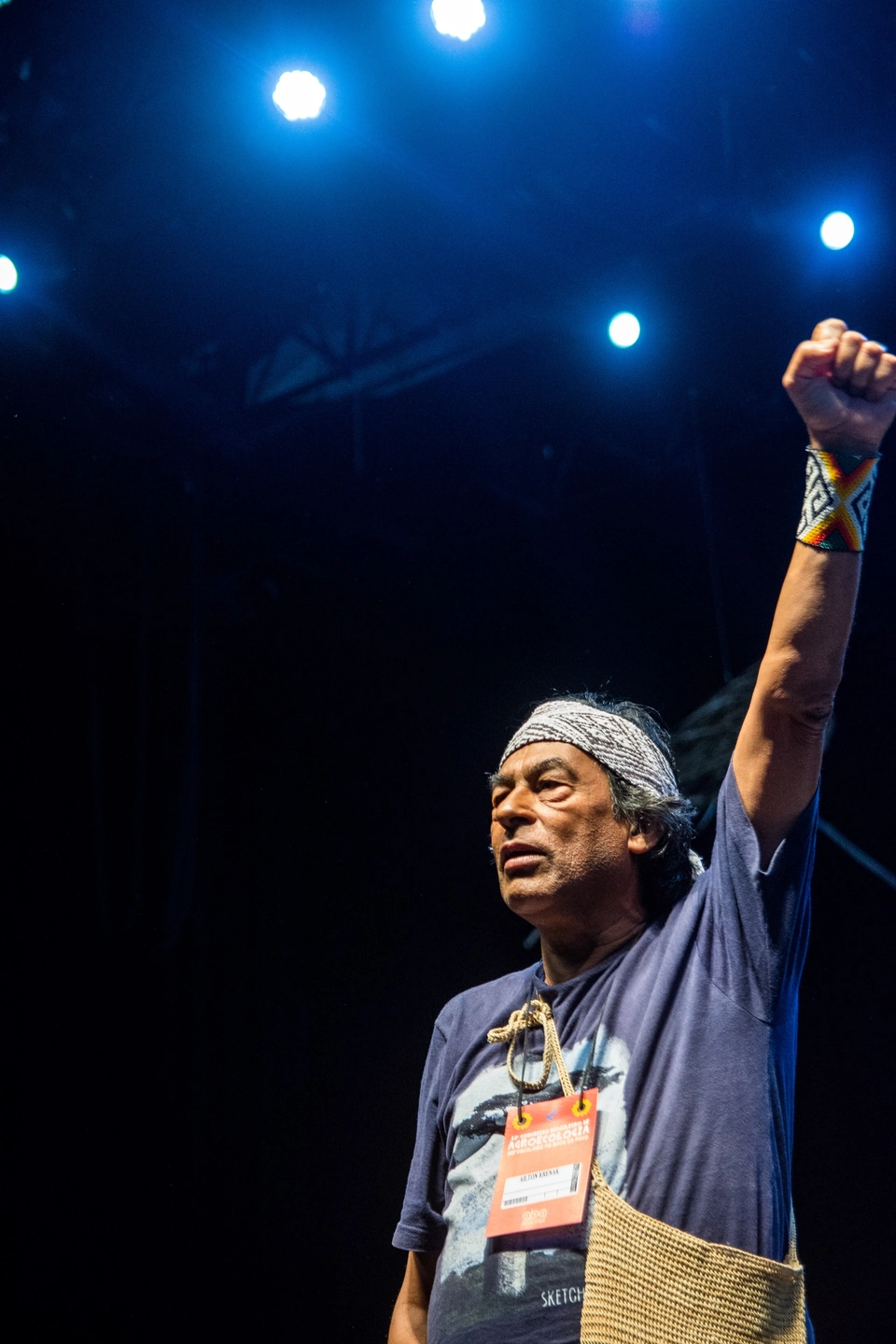 Image credit Ailton Krenak na conferência de encerramento do 12º Congresso Brasileiro de Agroecologia, em 23 de novembro de 2023. November 23, 2023. Foto: 12º Congresso Brasileiro de Agroecologia (ABA-Agroecologia) via Flickr · CC BY-SA 2.0 License CC BY-SA 2.0 People indicated by the source: Krenak.
Ailton Krenak (in Portuguese)
is about
escritor · ativista indígena dos direitos humanos

Languages
Nheengatu (in Portuguese)
Language of the Tupi-Guarani family (Tupi stock) descended from the Língua Geral Amazônica of the colonial period. Today it is spoken mainly in the middle…
Organizations

Articulação dos Povos Indígenas do Brasil (Apib) (in Portuguese)
is about
National body of the Indigenous movement in Brazil, created at the 2005 Acampamento Terra Livre, which brings together regional Indigenous organizations…
External references
References from other sites, checked on November 19, 2026. Their content is the responsibility of each site.
| Site | Type | Identifier |
|---|---|---|
| Portuguese Wikipedia · Constituição brasileira de 1988 (opens in a new tab) | Encyclopedias | — |
| Wikidata · Constituição brasileira de 1988 (opens in a new tab) | Encyclopedias | Q2386422 |
Provenance of the information
Recorded statements
41
Each piece of information on this page has a status and the sources that support it.
- 37 confirmed by a source
- 2 editorial inferences
- 1 searched for and not found
- 1 pending consultation with the peoples
Where sources disagree
No disagreement between sources recorded on this page.
Pending consultation with the peoples
1
One piece of information depends on consulting the peoples themselves, which the portal has not done yet. Until then, the text stays off the site.
Sources
20
- 9 government bodies
- 6 legal texts
- 2 reference institutions
- 1 press
- 1 Indigenous organization
- 1 academic study
Last research
November 19, 2026
Spotted an error? Contribute (in Portuguese)
How to cite this page
Version of . The access date is today’s.
- ABNT
-
PORTAL POVOS INDÍGENAS. Indigenous rights in the 1988 Constitution. [S. l.], 2026. Disponível em: https://povosindigenas.com.br/en/articles/direitos-indigenas-na-constituicao-de-1988/. Acesso em: dia do seu acesso.
- APA
-
Portal Povos Indígenas. (2026, November 19). Indigenous rights in the 1988 Constitution. Retrieved date of your access, from https://povosindigenas.com.br/en/articles/direitos-indigenas-na-constituicao-de-1988/