 PT
 EN
 ES
 FR
Blog
Indigenous women in politics and in the movement: the Marcha, Anmiga and three trajectories
What Anmiga, research and official records say about the Marcha das Mulheres Indígenas and about three Indigenous women in Congress and in government.

This post brings together what sources opened by the editorial team record about the Marcha das Mulheres Indígenas (Indigenous Women's March), the articulation that organizes it, and three Indigenous women with an entry on the portal who held positions in Congress and in the federal government. It is not a complete history of the political participation of Indigenous women in Brazil.
The first March and Anmiga
According to Anmiga (in Portuguese), Indigenous women created a space of their own for action during the 2019 Acampamento Terra Livre (ATL, the Free Land Camp), in Brasília. This space grew stronger with the 1st Marcha das Mulheres Indígenas, which the organization dates to August 9, 2019, the International Day of the World's Indigenous Peoples. Anmiga speaks of 2,500 women from 130 peoples and records the march's motto: "Território: nosso corpo, nosso espírito" ("Territory: our body, our spirit").1
The articulation was officially founded on March 8, 2021, with the Manifesto das Primeiras Brasileiras (Manifesto of the First Brazilian Women), and brings together women from the country's six biomes: the Amazon, the Cerrado (Brazil's tropical savanna), the Caatinga (a dry scrub forest of the Northeast), the Atlantic Forest, the Pampa and the Pantanal. Since 2024, its legal entity has been the Instituto Guardiãs da Ancestralidade. The organization says it holds the March every two years.23
What research says about the March
In a 2021 article in the journal PerCursos, of Udesc, Mariana de Castilho and Sílvia Guimarães, of the Universidade de Brasília, analyze the first March based on press coverage and interviews with participants. For the authors, "A Marcha foi o local que promoveu uma fissura, que está aberta" ("The March was the place that brought about a fissure, which is open").4
In 2026, Janaina Betto and Marcos Botton Piccin, of the Universidade Federal de Santa Maria, described the March as the "evento deliberativo máximo" ("highest deliberative event") of the network of Indigenous women. According to them, this network acts in "processos de oposição e composição com o Estado" ("processes of opposition to and composition with the State").5
The fourth March, in 2025
In August 2025, the 4th Marcha das Mulheres Indígenas took place together with the 1st National Conference of Indigenous Women, in Brasília. According to Agência Gov, the conference began on August 4, was coordinated by the Ministry of Indigenous Peoples and the Ministry of Women, with the support of Anmiga, and had as its theme "Mulheres Guardiãs do Planeta pela cura da Terra" ("Women Guardians of the Planet for the healing of the Earth"). The march's motto was "Nosso corpo, nosso território: somos as guardiãs do planeta" ("Our body, our territory: we are the guardians of the planet").6
Brasil de Fato reported that, on August 7, the participants walked to the National Congress against bill 2159, which they called the "PL da Devastação" ("Devastation Bill"), and delivered the Carta dos Corpos-Territórios em Defesa da Vida (Letter of the Body-Territories in Defense of Life). The letter came out of the conference, with five axes: territorial management, climate emergency, gender violence, health and education. The newspaper speaks of more than 5,000 women, without saying who did the count.7
Célia Xakriabá
In an interview with Sumaúma in February 2023, Célia Xakriabá (in Portuguese) introduced herself this way: "Sou Célia Xakriabá, do povo indígena Xakriabá, do bioma Cerrado" ("I am Célia Xakriabá, of the Xakriabá Indigenous people, from the Cerrado biome"). In the same conversation, she said she was a co-founder of Anmiga and "a primeira indígena deputada federal pelo estado de Minas Gerais" ("the first Indigenous woman federal deputy for the state of Minas Gerais"). About the articulation, she stated: "O século 21 é das mulheres indígenas" ("The 21st century belongs to Indigenous women").8
The Chamber of Deputies records that she took office on February 1, 2023, for PSOL in Minas Gerais (in Portuguese), for the 2023–2027 term. She chaired the Committee on the Amazon and on Original and Traditional Peoples from March 2023 to March 2024 and the Committee for the Defense of Women's Rights from March 2025 to March 2026. At the 4th March, according to Brasil de Fato, she said that "quem tem condição de reabrir os trabalhos no Congresso Nacional são as mulheres indígenas" ("those who are in a position to reopen the work in the National Congress are Indigenous women").910
Sonia Guajajara
According to the Ministry of Indigenous Peoples, Sonia Guajajara (in Portuguese) was born in 1974 in the Araribóia (in Portuguese) Indigenous Land (Terra Indígena, TI — a legal category under Brazilian law), in Maranhão (in Portuguese), and belongs to the Guajajara/Tentehar people. She was part of Coapima, Coiab (in Portuguese) and the Apib (in Portuguese) (Articulação dos Povos Indígenas do Brasil), where she was executive coordinator. The ministry presents her as Brazil's first Indigenous woman minister. She left the post on March 31, 2026.11
Joenia Wapichana
The Chamber records that Joenia Wapichana (in Portuguese) is a lawyer, with a law degree from the Universidade Federal de Roraima in 1997 and a master's degree from the University of Arizona, and that she served as federal deputy for Roraima (in Portuguese), for the Rede party, from 2019 to 2023.12
A Mongabay report from February 2023 describes her as the first Indigenous woman elected federal deputy, in 2018, and the first Indigenous woman appointed president of the Fundação Nacional dos Povos Indígenas (Funai, Brazil's federal Indigenous affairs agency). In April 2026, according to the Ministry of Indigenous Peoples, Lúcia Alberta Baré (in Portuguese) took over the presidency of Funai, where Joenia had been the previous president.1314
Read also
See the blog (in Portuguese)-
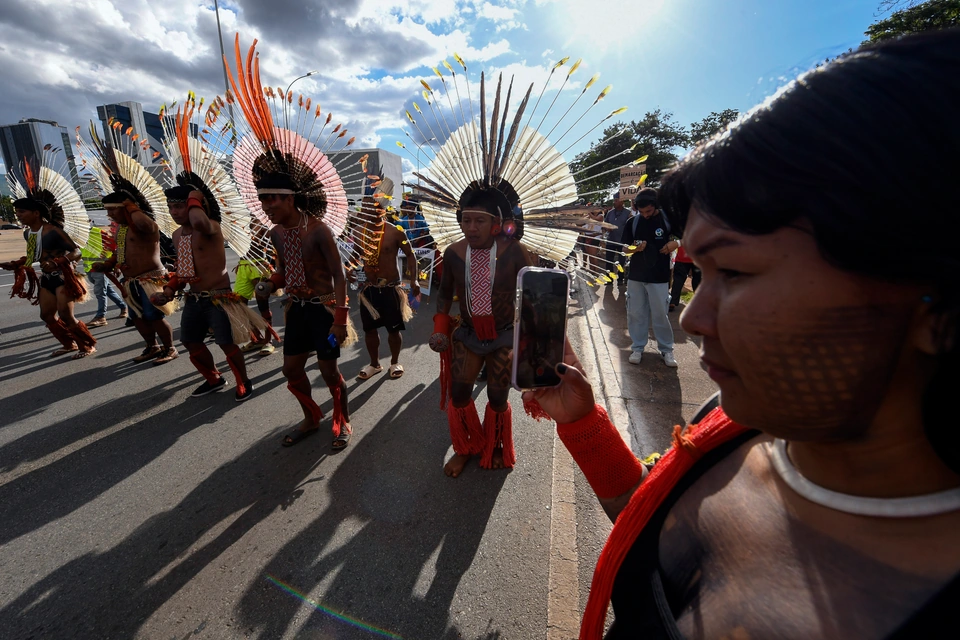 Image credit Acampamento Terra Livre 2024, in Brasília, on the 20th anniversary of the ATL. Foto: Agência Senado via Flickr · CC BY 2.0 License CC BY 2.0
movimento indígena · apib · acampamento terra livre
Acampamento Terra Livre: what the ATL is
O Acampamento Terra Livre é a mobilização nacional anual organizada pela Apib, que nasceu no ATL de 2005. O post reúne o que as fontes dizem sobre a origem, a edição online de 2020 e a de 2026, e registra uma diferença na contagem das edições.
4-minute read
-
terras indígenas · desmatamento · meio ambiente
How Indigenous peoples help prevent deforestation
O que as pesquisas dizem sobre o efeito do reconhecimento das terras, da vigilância e do monitoramento indígena no desmatamento, o retrato de 2024 do MapBiomas e a pressão do garimpo e das invasões.
5-minute read
-
terras indígenas · direitos · legislação
How an Indigenous Land is demarcated
Do art. 231 da Constituição ao registro em cartório: o que a lei chama de terra tradicionalmente ocupada, as etapas do Decreto 1.775/1996, os prazos não cumpridos e o que mudou com a Lei 14.701/2023.
4-minute read

Provenance of the information
Recorded statements
15
Each piece of information on this page has a status and the sources that support it.
- 14 confirmed by a source
- 1 searched for and not found
Where sources disagree
No disagreement between sources recorded on this page.
Sources
11
- 5 government bodies
- 3 press
- 2 academic studies
- 1 Indigenous organization
Last research
November 19, 2026
Spotted an error? Contribute (in Portuguese)
How to cite this page
Version of . The access date is today’s.
- ABNT
-
PORTAL POVOS INDÍGENAS. Indigenous women in politics and in the movement: the Marcha, Anmiga and three trajectories. [S. l.], 2026. Disponível em: https://povosindigenas.com.br/en/blog/mulheres-indigenas-na-politica-e-no-movimento/. Acesso em: dia do seu acesso.
- APA
-
Portal Povos Indígenas. (2026, November 19). Indigenous women in politics and in the movement: the Marcha, Anmiga and three trajectories. Retrieved date of your access, from https://povosindigenas.com.br/en/blog/mulheres-indigenas-na-politica-e-no-movimento/