 PT
 EN
 ES
 FR
Blog
What the 2022 Census changed in the count of Indigenous peoples
The question "Você se considera indígena?" ("Do you consider yourself Indigenous?") moved beyond Indigenous Lands, and this weighs on the comparison with 2010.
The 2022 Census (Censo Demográfico 2022) counted 1,694,836 Indigenous people in Brazil, 0.83% of the population enumerated. In 2010, the IBGE (Brazilian Institute of Geography and Statistics) had counted 896,917, which corresponded to 0.47% of the population. By the institute's own calculations, the Indigenous population practically doubled in twelve years, a change of 88.96%.13
The 2022 figure changed once after the first release. The 2023 publication, with the first results of the universe, gave 1,693,535 people. The 2025 publication on ethnic groups and languages gives 1,694,836 and indicates as its origin a second tabulation of those first results.2
The IBGE itself warns that the growth cannot be read only as the effect of births and deaths. What also changed was the way of counting.4
Two questions, not one
In the Census, a person is counted as Indigenous in two ways. The first is the question about color or race, asked of all residents of all households, when the answer is "indígena" ("Indigenous"). The second is a coverage question, "Você se considera indígena?" ("Do you consider yourself Indigenous?"), asked of those who did not choose "Indigenous" in the color or race question. The total number of Indigenous people is the sum of the two answers.5
The principle behind both questions is self-identification. The IBGE relies on ILO Convention 169, which treats self-identification as a "critério fundamental" ("fundamental criterion") for defining ethnic belonging. In the consultations that prepared the Census, specialists asked that the training of enumerators reinforce this principle. The declaration could not be questioned by the data collection agents under any circumstances, even when the person was unable to state their ethnic group.19
What changed from 2010 to 2022
The question "Você se considera indígena?" debuted in 2010, but it was asked only inside Indigenous Lands (Terra Indígena, TI — a legal category under Brazilian law). In 2022, it came to be asked in all the Indigenous localities mapped by the IBGE. These include the officially delimited Indigenous Lands, Indigenous groupings and the other Indigenous localities identified by the institute. Also in cities and in areas of dispersed occupation.6
In 2022, the question was asked of 18,669,778 people. 467,097 answered "yes", which comes to 2.50% of those who heard the question.7
The weight of this second route changed considerably. In 2010, it accounted for 8.80% of the country's total Indigenous population. In 2022, it accounted for 27.58%: 3.55% of Indigenous people living in Indigenous Lands and 41.53% of those living outside them.8
According to the IBGE, the change responded to requests made in the free, prior and informed consultation with the representative organizations of Indigenous peoples, the agencies of Indigenous policy and the academic associations. The hypothesis presented at these meetings was that the 2010 Census had failed to count part of the Indigenous population living outside Indigenous Lands. The institute writes that the 2022 results confirmed this hypothesis.9
Other changes came into play. The mapping of Indigenous localities was expanded, including in cities and in remote areas. There were also Indigenous community guides, differentiated training of the teams and real-time monitoring of data collection. The IBGE says that these changes, together with the broader reach of the question, may partly explain the increase between the two censuses.4
Where they live
According to the first 2022 results, 622,066 Indigenous people (36.73%) lived in Indigenous Lands and 1,071,469 (63.27%) outside them. Most of the enumerated Indigenous population therefore lives outside the officially delimited lands. This is precisely the group in which the coverage question carried more weight.108
Ethnic groups: 391
The 2022 Census recorded 391 Indigenous ethnic groups, peoples or groups, against 305 in 2010. In Indigenous Lands there were 335, against 250 in 2010. Outside them, there were 373, against 300.11
In 2022, each person could declare up to two ethnic groups. In all, 1,262,812 Indigenous people declared an ethnic group, people or group, or 74.51% of the Indigenous population. Of these, 1.43% declared two.12
Some do not appear under any ethnic group. The share of Indigenous people with no declared ethnic group went from 6.00% in 2010 to 9.85% in 2022. The share of cases in which the respondent could not say the ethnic group fell from 16.41% to 13.05%.13
The most numerous ethnic groups were the Tikúna (in Portuguese), with 74,061 people, the Kokama (in Portuguese), with 64,327, and the Makuxí (in Portuguese), with 53,446.16
Languages: 295
The 2022 Census recorded 295 Indigenous languages spoken or used at home by Indigenous people aged 2 or older. Each person could name up to three languages. Answers classified as ill-defined, undetermined and undeclared, among others, were left out of the count. In 2010, there were 274 languages. The IBGE published guidance for comparing the two censuses, because some languages were merged, split or changed code.14
In total, 474,856 Indigenous people aged 2 or older (29.19%) spoke or used an Indigenous language at home. Of these, 372,001 lived in Indigenous Lands. The languages with the most speakers were Tikúna (51,978), Guarani Kaiowá (38,658), Guajajara (in Portuguese) (29,212) and Kaingang (in Portuguese) (27,482).1517
How to read the numbers
The 2010 and 2022 figures come from questions applied in different ways. The comparison is valid as an order of magnitude, always with this caveat. The IBGE itself says that the change in population between the two censuses cannot be explained by demographic factors alone. It also says that only the release of data by sex, age, ethnic group, mortality, fertility and migration will make it possible to better understand this increase.418
Read also
See the blog (in Portuguese)-
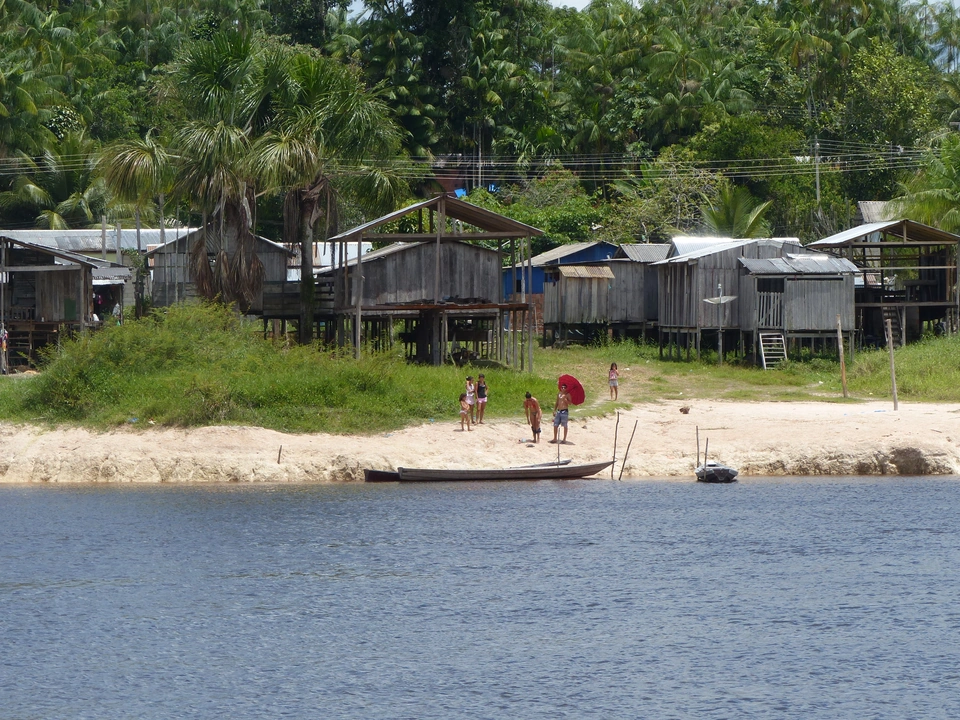 Image credit Comunidade na beira do Rio Negro, vista de barco antes de chegar a Santa Isabel (AM). Foto: Isabelle Allet-Coche / Wikimedia Commons (trabalho próprio) · CC BY-SA 4.0 License CC BY-SA 4.0
línguas · unesco · políticas públicas · censo 2022
The International Decade of Indigenous Languages (2022–2032): what it is and what is happening in Brazil
A ONU proclamou 2022–2032 como a Década Internacional das Línguas Indígenas. O post explica o que a resolução diz, o que o Censo 2022 mostra e como um grupo de trabalho indígena organizou o plano brasileiro.
5-minute read
-
educação · línguas · legislação
Indigenous school education and Lei 11.645/2008
A Lei 11.645/2008 obriga todas as escolas de ensino fundamental e médio a ensinar história e cultura indígena; a escola nas comunidades indígenas tem outra base legal, na Constituição e na LDB. O post separa os dois temas e indica pesquisas sobre casos concretos.
5-minute read
-
terras indígenas · desmatamento · meio ambiente
How Indigenous peoples help prevent deforestation
O que as pesquisas dizem sobre o efeito do reconhecimento das terras, da vigilância e do monitoramento indígena no desmatamento, o retrato de 2024 do MapBiomas e a pressão do garimpo e das invasões.
5-minute read

Provenance of the information
Recorded statements
19
Each piece of information on this page has a status and the sources that support it.
- 19 confirmed by a source
Where sources disagree
No disagreement between sources recorded on this page.
Sources
3
- 3 government bodies
Last research
November 19, 2026
Spotted an error? Contribute (in Portuguese)
How to cite this page
Version of . The access date is today’s.
- ABNT
-
PORTAL POVOS INDÍGENAS. What the 2022 Census changed in the count of Indigenous peoples. [S. l.], 2026. Disponível em: https://povosindigenas.com.br/en/blog/o-que-o-censo-2022-mudou-na-contagem-dos-povos-indigenas/. Acesso em: dia do seu acesso.
- APA
-
Portal Povos Indígenas. (2026, November 19). What the 2022 Census changed in the count of Indigenous peoples. Retrieved date of your access, from https://povosindigenas.com.br/en/blog/o-que-o-censo-2022-mudou-na-contagem-dos-povos-indigenas/