 PT
 EN
 ES
 FR
Blog
Indigenous school education and Lei 11.645/2008
What all schools must teach about Indigenous peoples and what the law says about schools in Indigenous communities.
When people talk about schools and Indigenous peoples in Brazil, two subjects tend to come up together, but the law deals with them in different places. One is what elementary and secondary schools, public and private, must teach about Indigenous peoples. The other is the school that operates in Indigenous communities, with its own rules. This post separates the two and points to some reading on each.13
What Lei 11.645/2008 requires
Lei 11.645 (in Portuguese) of March 10, 2008 (the law requiring the teaching of Indigenous history and culture in schools) amended Article 26-A of the Lei de Diretrizes e Bases da Educação Nacional (in Portuguese) (LDB (in Portuguese), Brazil's national education guidelines and framework law, Lei 9.394/1996 (in Portuguese)). Since then, the text has said that "nos estabelecimentos de ensino fundamental e de ensino médio, públicos e privados, torna-se obrigatório o estudo da história e cultura afro-brasileira e indígena" ("in elementary and secondary educational establishments, public and private, the study of Afro-Brazilian and Indigenous history and culture becomes mandatory").1
The article already existed. It had been included in the LDB (in Portuguese) by Lei 10.639 of 2003, which made teaching about "História e Cultura Afro-Brasileira" ("Afro-Brazilian History and Culture") mandatory. The 2008 law added Indigenous history and culture.2
The law also says what goes into the content. It must include aspects of the history and culture that shaped the Brazilian population from these two groups, such as "a luta dos negros e dos povos indígenas no Brasil" ("the struggle of Black people and of Indigenous peoples in Brazil") and "a cultura negra e indígena brasileira" ("Brazilian Black and Indigenous culture"). And this content must be taught "no âmbito de todo o currículo escolar, em especial nas áreas de educação artística e de literatura e história brasileiras" ("throughout the entire school curriculum, especially in the areas of art education and of Brazilian literature and history"). It is therefore not a separate subject.3
The Indigenous school in the law
The school in Indigenous communities has a different basis. The 1988 Constitution says, in Article 210, Paragraph 2, that regular elementary education shall be given in the Portuguese language, but guarantees Indigenous communities "também a utilização de suas línguas maternas e processos próprios de aprendizagem" ("also the use of their mother tongues and their own learning processes"). The LDB (in Portuguese) repeats the rule in Article 32, Paragraph 3. The constitutional context is in the article Indigenous rights in the 1988 Constitution.4
The LDB (in Portuguese) devotes two articles to the subject. Article 78 requires the Union (the federal government) to develop integrated teaching and research programs "para oferta de educação escolar bilingüe e intercultural aos povos indígenas" ("to provide bilingual and intercultural school education to Indigenous peoples"). Among the objectives are the recovery of historical memories, the reaffirmation of ethnic identities and the valuing of the languages and sciences of these peoples. Another objective is to guarantee access to the technical and scientific knowledge of national society and of other societies.5
Article 79 says that the Union provides technical and financial support to the education systems for intercultural education for Indigenous communities. The programs must be "planejados com audiência das comunidades indígenas" ("planned with a hearing of the Indigenous communities"). Among their objectives are strengthening the sociocultural practices and the mother tongue of each community and training specialized staff. They must also develop specific curricula and publish specific and differentiated teaching materials.6
The expression "escola diferenciada" ("differentiated school"), common in the debate, appears in the research cited below. The LDB (in Portuguese) speaks of "educação escolar bilingüe e intercultural" ("bilingual and intercultural school education") and of "material didático específico e diferenciado" ("specific and differentiated teaching materials").14
What some research records
The portal's readings on languages and education include studies of concrete cases. Some examples:
- In Os Kambeba, a escola e seus significados (The Kambeba (in Portuguese), the school and its meanings) (Tellus journal, 2020), researchers from the Universidade Federal do Amazonas study how the Kambeba of the Betel community, in the Barreira da Missão Indigenous Land (Terra Indígena, TI — a legal category under Brazilian law), in Amazonas (in Portuguese), see the community's rural municipal Indigenous school. The article describes the school as something that "um dia foi palco para homogeneização e negação das diferenças étnicas" ("was once a stage for homogenization and the denial of ethnic differences") and says that today it is the place of new possibilities. It also says that this struggle "se torna possível com a promulgação da Constituição Federal de 1988 (in Portuguese)" ("becomes possible with the promulgation of the 1988 Federal Constitution").7
- In Percepções Paiter Suruí sobre legislações da Educação Escolar Indígena (Paiter Suruí (in Portuguese) perceptions of Indigenous School Education legislation), the authors listened to Paiter Suruí elders from the Apoena Meirelles village, in the Sete de Setembro Indigenous Land, in research carried out in 2018 and 2019. According to the abstract, they "observam a escola como um espaço de conquista, espaço que necessita continuar se aproximando dos pressupostos legais" ("see the school as a space of achievement, a space that needs to keep moving closer to the legal premises").8
- In Diretrizes de educação escolar indígena dos povos Munduruku e Apiaká do Planalto Santareno (Indigenous school education guidelines of the Munduruku (in Portuguese) and Apiaká (in Portuguese) peoples of the Planalto Santareno) (Tellus, 2025), Iara Tatiana Bonin and Francineide Lima Abreu follow the working group that wrote the school education guidelines for five villages in Santarém (PA). The final text, launched on March 10, 2023, serves as the basis for the schools' political-pedagogical projects and draws, among other norms, on Article 78 of the LDB (in Portuguese).9
- In Diálogos interescolares e interculturais (Inter-school and intercultural dialogues) (UnB, 2025), Janaína Meira Reis studies the exchange of letters between secondary school classes in the Distrito Federal (in Portuguese) and the Território Indígena do Xingu as a way of complying with Lei 11.645 (in Portuguese). The master's thesis starts from stereotyped perceptions of Indigenous peoples and concludes that, despite the limits, the exchanges generated dialogue and critical reflection.10
- In Linguística e educação indígena com muito amor (Linguistics and Indigenous education with much love) (Revista Brasileira de Linguística Antropológica, 2024), Loretta Emiri reconstructs the history of Indigenous school education in Brazil from Roraima (in Portuguese) and from her own experience. She worked at the Diocese of Roraima, the state Department of Education, the Conselho Indigenista Missionário (in Portuguese), the Centro de Documentação e Informação and the Operação Anchieta.11
What this post does not include
Read also
See the blog (in Portuguese)-
terras indígenas · direitos · legislação
How an Indigenous Land is demarcated
Do art. 231 da Constituição ao registro em cartório: o que a lei chama de terra tradicionalmente ocupada, as etapas do Decreto 1.775/1996, os prazos não cumpridos e o que mudou com a Lei 14.701/2023.
4-minute read
-
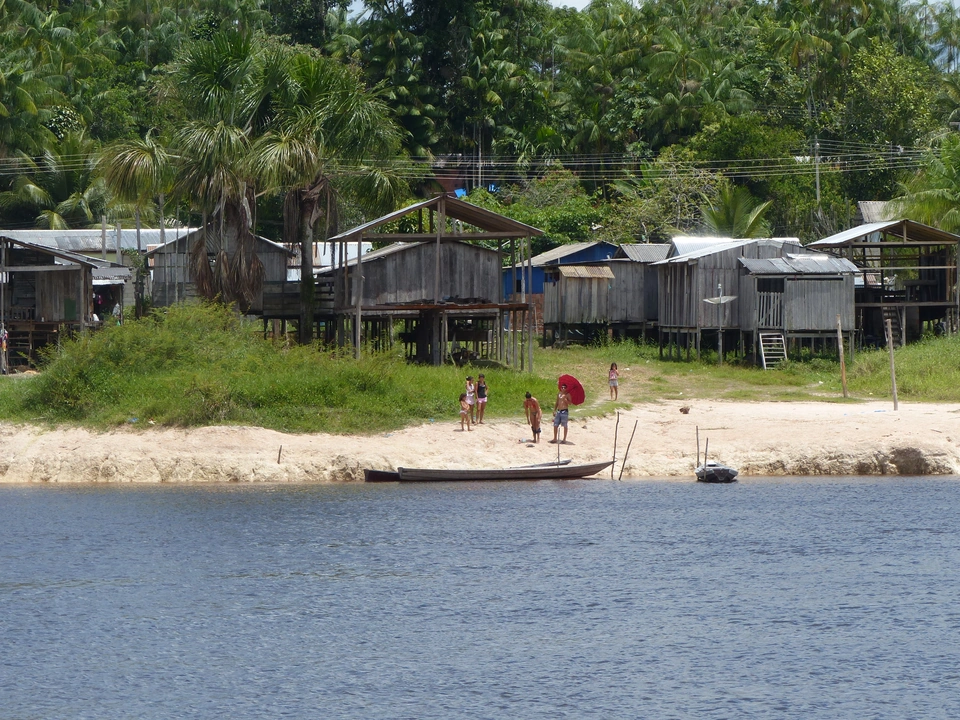 Image credit Comunidade na beira do Rio Negro, vista de barco antes de chegar a Santa Isabel (AM). Foto: Isabelle Allet-Coche / Wikimedia Commons (trabalho próprio) · CC BY-SA 4.0 License CC BY-SA 4.0
línguas · unesco · políticas públicas · censo 2022
The International Decade of Indigenous Languages (2022–2032): what it is and what is happening in Brazil
A ONU proclamou 2022–2032 como a Década Internacional das Línguas Indígenas. O post explica o que a resolução diz, o que o Censo 2022 mostra e como um grupo de trabalho indígena organizou o plano brasileiro.
5-minute read
-
censo 2022 · ibge · demografia · línguas
What the 2022 Census changed in the count of Indigenous peoples
O Censo 2022 contou 1.694.836 pessoas indígenas, 391 etnias e 295 línguas. Parte da diferença em relação a 2010 vem da forma de perguntar: a pergunta "Você se considera indígena?" saiu das Terras Indígenas e passou a ser feita em todas as localidades indígenas mapeadas pelo IBGE.
5-minute read

Provenance of the information
Recorded statements
14
Each piece of information on this page has a status and the sources that support it.
- 11 confirmed by a source
- 2 editorial inferences
- 1 searched for and not found
Where sources disagree
No disagreement between sources recorded on this page.
Sources
8
- 5 academic studies
- 3 legal texts
Last research
November 19, 2026
Spotted an error? Contribute (in Portuguese)
How to cite this page
Version of . The access date is today’s.
- ABNT
-
PORTAL POVOS INDÍGENAS. Indigenous school education and Lei 11.645/2008. [S. l.], 2026. Disponível em: https://povosindigenas.com.br/en/blog/educacao-escolar-indigena-e-a-lei-11645-2008/. Acesso em: dia do seu acesso.
- APA
-
Portal Povos Indígenas. (2026, November 19). Indigenous school education and Lei 11.645/2008. Retrieved date of your access, from https://povosindigenas.com.br/en/blog/educacao-escolar-indigena-e-a-lei-11645-2008/